
Home > Home Solar Info > Solar just became a 2026 election issue
Labour and National have both promised to help New Zealanders pay for solar without the big upfront bill. Here's exactly what each is offering, how they differ — and whether it changes anything if you're thinking about solar right now.
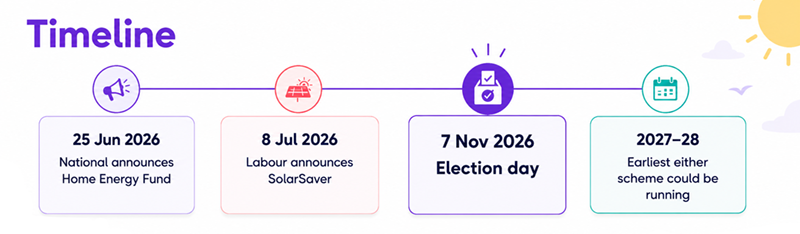
Neither policy exists yet — you can't apply for either one today. Both SolarSaver and the Home Energy Fund are election promises, not current law or funded programmes. Whether either happens at all depends on who wins on 7 November 2026, and even then both would need legislation and set-up time before a single loan or subsidy is paid out.
You don't have to wait for either party's scheme to exist. Several NZ banks already offer dedicated solar loans, and on interest rate alone, they currently beat what either party is proposing. Full details and links: mysolarquotes.co.nz/about-solar-power/residential/financing-solar
Current low- and zero-interest bank loans for solar power in New Zealand (updated July 2026)
| Lender | Interest Rate | Max Loan | Loan Term | Eligibility & Notes |
|---|---|---|---|---|
| ANZ Good Energy Home Loan | 1% | $80,000 | 3 years | Mortgage top-up; requires at least 20% equity; quote must be from a SEANZ-member solar company. More details |
| ASB Better Homes Top-Up | 1% | $80,000 | 3 years | Mortgage top-up; needs a quote/invoice no more than 60 days old; SEANZ-member installer. More details |
| BNZ Green Home Loan Top-Up | 1% | $80,000 | 3 years | Mortgage top-up; quote must be from a SEANZ-member solar company. More details |
| Westpac Warm Up Loan | 0% | $50,000 | Up to 5 years | Mortgage top-up; needs a quote/invoice no more than 90 days old; SEANZ-member installer. More details |
| ASB SMART Solar Loan | 0% | $150,000 | 5 years | Rural properties only; for existing or new ASB rural banking customers; professional installation required. More details |
| Kiwibank Sustainable Energy Loan | Variable rate | — | 7–10 years | Home loan top-up; borrow over $5,000 and get up to $2,000 back over 4 years; quote must be from a SEANZ-member solar company. More details |
Most of these are mortgage top-ups, so you'll typically need an existing mortgage and 20%+ equity. Personal loans and “interest-free” finance from providers like Q Card also exist, but rates typically jump to around 26% p.a. after the first year, so these are best avoided unless you can clear the balance within the interest-free period.
Short answer: on interest rate, yes — by a wide margin, though it's not a perfect apples-to-apples comparison. Here's what we found:
Bottom line: your instinct is right — if you can get one of the current bank loans, the interest rate is very likely to beat whatever National's scheme ends up offering, and it's already available rather than dependent on winning an election and passing legislation. The trade-off is term length and eligibility (mortgage + 20% equity), not rate.
What each party is actually promising
Both plans borrow the same basic idea — a low-interest, long-term loan so you don't pay for solar upfront — from the Ratepayer Assistance Scheme model designed by Local Government NZ and Rewiring Aotearoa. From there, they diverge.
| Labour — SolarSaver Announced 8 July 2026 ($160 million over four years) |
|
|---|---|
| Funded by | Repurposing the Government's Gas Security of Supply fund |
| Cash subsidy | Up to $3,000 kickstart subsidy for low- and middle-income owners and renters |
| Homeowner finance | Two loan options — via your lines company (repaid through power bills) or a rates-linked Ratepayer Assistance Scheme loan |
| Indicative interest rate | Lines company loan capped at the lines company's “regulated cost of capital”, currently around 6.5%; the Ratepayer Assistance Scheme option is designed to sit below floating mortgage rates |
| Renters | Rule changes to legalise plug-in “balcony” solar — currently against the rules in NZ, needs about 12 months to fix |
| Extras | $30 million community battery fund; free EECA advice service; $4 million for workforce training |
| Timeline promise | Running within 12 months of taking office |
| Depends on | Labour winning the 7 November 2026 election, then legislation being passed |
| National — Home Energy Fund Announced 25 June 2026 ($7 million Crown equity plus council funding) |
|
|---|---|
| Funded by | $7 million one-off Crown investment for a 20% stake, with the balance funded by participating councils and the Local Government Funding Agency |
| Cash subsidy | None — loan-only, no direct grants |
| Homeowner finance | One loan type, secured against your property, repaid through rates over about 10 years. Requires at least 20% equity |
| Indicative interest rate | Not announced. Described only as “low-interest” or “competitive”. Based on the same Ratepayer Assistance Scheme model, independent estimates suggest a rate of roughly 4–4.5%+ |
| Renters | No direct mechanism, though National's energy minister has asked officials to look at legalising plug-in solar too |
| Extras | Also covers batteries, insulation and heat pumps; removes the resource consent requirement for small-scale solar and battery installs |
| Timeline promise | Voluntary council-by-council rollout if re-elected; no fixed start date given |
| Depends on | National being re-elected on 7 November 2026, plus individual councils opting in |
| Labour — SolarSaver | National — Home Energy Fund | |
|---|---|---|
| Total cost | $160 million over 4 years | $7m Crown equity; total scale depends on council uptake |
| Covers | Rooftop solar, batteries, plug-in solar | Solar, batteries, insulation, heat pumps & other electrification |
| Upfront cash grant | Up to $3,000 for eligible households | None |
| Loan repayment | Via power bill, or via rates (RAS) | Via rates only, over ~10 years |
| Indicative interest rate | Lines company loan capped at “regulated cost of capital”, ~6.5% today; RAS option designed to sit below floating mortgage rates | Not announced. Described only as “low-interest” / “competitive” — based on the same RAS model, independent estimates suggest ~4–4.5%+ |
| Who qualifies | Homeowners; low/middle-income households and renters get extra help | Homeowners with 20%+ equity in their property |
| Renters | Targeted plug-in subsidy + legal change | Not directly addressed |
| Community sharing | $30m community battery fund | Not included |
| Consent rules | Not a focus of this policy | Removes resource consent for small-scale solar/battery/micro-hydro |
| Depends on | Labour winning the 7 Nov 2026 election | National being re-elected, plus councils opting in |
Both sides have accused the other of copying its policy. National's energy spokesperson called Labour's plan “essentially National's policy with a bigger price tag”, while Labour has criticised National for funding loans instead of subsidies and points out its own plan reaches renters, which National's doesn't directly. Neither policy is guaranteed to become law.
Nothing about either announcement stops you getting solar today, and nothing guarantees a scheme will exist to help you if you wait. Treat both policies as things to watch, not things to plan your household budget around.
Can I apply for SolarSaver or the Home Energy Fund right now?
No. Neither scheme is law. They are election policies that would only proceed if that party forms the next government after 7 November 2026, and each would still need to be legislated and set up afterwards.
Will getting solar now stop me from getting a future subsidy or loan?
Neither party has said existing systems would be excluded, but neither has confirmed they'd be included either. Both schemes appear aimed at households without solar yet who need help with the upfront cost.
Which policy is “better”?
It depends what you need. Labour's plan is larger, includes cash subsidies, and is the only one that directly helps renters. National's plan covers a wider range of home electrification (insulation, heat pumps) and removes consent requirements, but is loan-only and requires home equity. Neither is guaranteed to become policy.
Is there anything both parties agree on?
Yes — both want to make it easier to install “plug-in” balcony solar, and both are using a property-linked, rates-repaid loan model based on the Ratepayer Assistance Scheme designed by Local Government NZ and Rewiring Aotearoa.
What about other parties?
ACT's energy spokesperson has said the party won't support solar subsidies, arguing people who value solar should pay for it themselves. New Zealand First hadn't stated a clear position on solar policy as of this article. The Opportunity Party are in support of solar, but are yet to release their policy.
This document is an independent explainer, not affiliated with or endorsed by the Labour Party or the National Party. Policy details are based on public announcements as at 14 July 2026 and may change before the 7 November 2026 election. Figures, eligibility and timelines described are policy promises, not confirmed government programmes. For financial decisions about your own home, get independent advice suited to your circumstances.


© My Solar Quotes Limited 2026. All Rights Reserved.