


Another genuinely good move from the Electricity Authority - and I’ll admit, one I was slightly sceptical about at first.
The Electricity Authority (EA) oversees the rules that all lines companies across New Zealand operate under. That matters because lines companies are regional monopolies - homeowners don’t get to shop around if their local network decides to be conservative.
So when the EA strongly encouraged lines companies to lift standard solar export limits to 10kW, it was a big deal.
Why? Because export limits directly control how much excess solar power your home is allowed to send back into the grid. Higher limits mean more clean, locally generated electricity flowing from one household to another - without needing new big power plants or long transmission lines.
This shift didn’t come out of nowhere. The EA has been steadily putting work into supporting smarter, higher solar uptake across New Zealand. Alongside the 10kW export push, there’s also been a voltage limit increase, which allows networks to safely handle more variable supply and demand. In plain English: the grid can now tolerate more solar without freaking out.
The timing couldn’t be better.
Over the last few years, as solar uptake has accelerated, many networks have gone into protection mode. In the name of “network stability”, export limits were quietly cut back - often to 5kW, sometimes with little explanation. From a network perspective, that keeps things tidy. From a solar perspective, it’s been frustrating.
Lower export limits don’t stop people installing solar, but they do throttle how much benefit households - and the wider grid - can get from it. Less solar flowing house-to-house means more wasted generation and slower progress overall.
My initial scepticism came from the fact that the EA chose not to make this mandatory, instead framing it as a strong recommendation. That said, as the chart below shows, most lines companies are already falling into line.
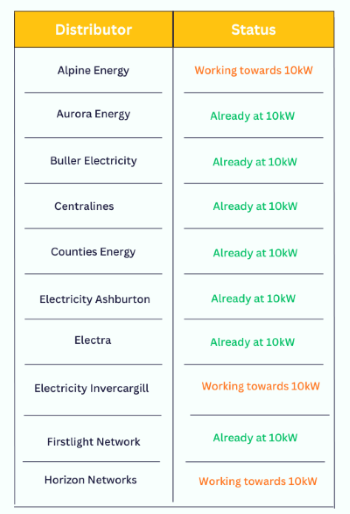
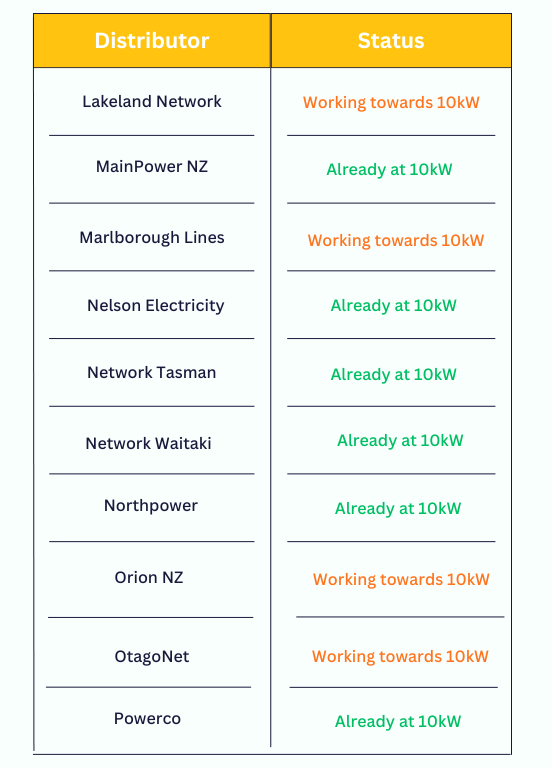
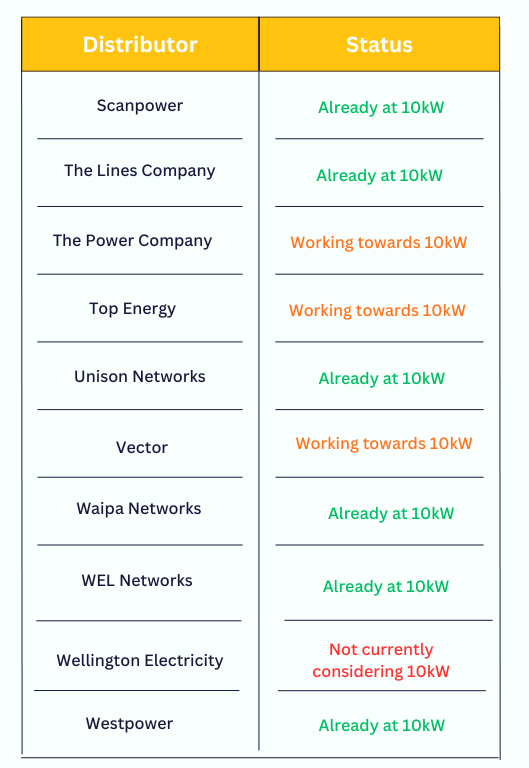
This chart is published on the EA’s website.
For the latest positions and any recent changes, it’s worth checking the live version on their website.
Encouraging 10kW export limits is a clear signal from the EA that solar is worth adapting for, not pushing back against. Solar does challenge lines companies, but if we genuinely want more renewable energy and a fairer electricity market, the networks need to evolve rather than default to restriction.


Vector in Auckland is just ridiculous when it comes to the increase to 10kw export. If you\'ve got an existing PV system and are allowed to export 5kw you can fill out a form on their website to increase the limit to 10kw. We did this and after 3 weeks we got this answer:\r\n\r\n\'Currently we have a 5kW export limit on single phase connections to our network, so your home would be limited to 5kW. We are working towards increasing this to 10kW in the future however do not yet have a confirmed date.\'\r\n\r\nSo what is the entire application for then? If they do not allow an increase anyway (at the moment) why putting out forms for the increase? So far Vector has not answered this question! :-( \r\n\r\nI hope the Electricity Authority will make it compulsory to increase the limit ASAP!