

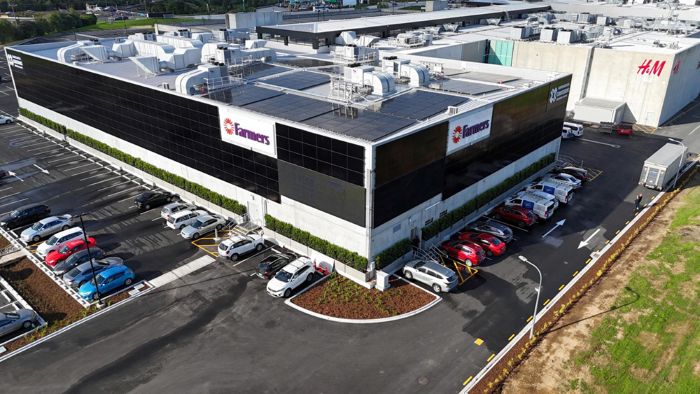
I recently had the chance to pick the brain of Yariv Edery from YEH about one of the most interesting commercial solar projects in New Zealand right now - the solar façade at Farmers, Tauranga Crossing.
Yariv has been running his New Zealand-based renewable energy consultancy for more than 21 years - so yes, he knows a thing or two. His team was brought in to handle the entire solar scope, from early-stage feasibility and performance modelling through to product selection, installation oversight and final commissioning.
At first glance, it just looks like a modern retail building with a sharp exterior. But look closer and you realise something different is going on. The walls are generating power.
Not just the roof. The walls.
And that raises a bunch of questions.
- Is this just a sustainability flex?
- Is it actually economical?
- How does a vertical solar panel even compare to a rooftop system?
- And is this something we’re going to see more of across New Zealand?
Commercial buildings are huge energy users. They have massive cooling loads, long operating hours, and usually very limited usable roof space once HVAC plant and services are factored in. So if we’re serious about decarbonising commercial property, we need to start thinking beyond just the roof.
This project does exactly that.
I asked Yariv a series of practical, technical, and economic questions about the design, the performance, and whether solar façades are actually a smart move - or just a design statement.
Here’s what he said.
What inspired the decision to install a solar façade on the Farmers building?
The project was driven by a shared sustainability vision between Farmers and Tauranga Crossing.
Both organisations wanted to visibly demonstrate their commitment to clean energy while reducing operating costs.
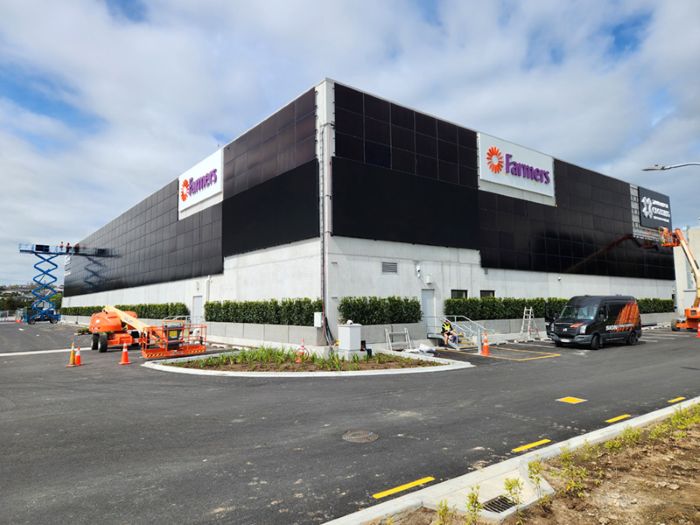
Because usable roof space was constrained by mechanical plant and ductwork, the vertical façades presented an opportunity to expand on-site solar generation without compromising building operations.
The façade system also integrates seamlessly with the building’s green wall and architectural features, reinforcing the sustainability narrative.
Was there a financial driver behind the installation?
Yes. On-site solar generation reduces electricity costs and provides long-term price certainty. That certainty supports better financial planning for both landlord and tenant and enabled a longer-term lease structure.
By lowering peak demand from mechanical air-conditioning systems, the installation also helps manage one of the largest components of commercial electricity bills.
Why use solar panels on walls instead of just the roof?
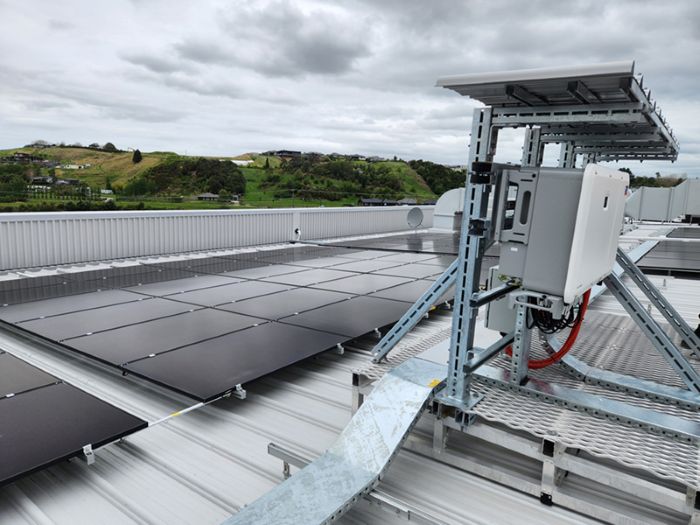
The system includes rooftop solar as well. However, roof space alone was not sufficient to meet the desired generation capacity.
Vertical façades allowed the building to increase total installed solar capacity, generating electricity during morning and late-afternoon periods, diversify production across multiple orientations, and improve winter performance due to low sun angles.
Together, the rooftop and façade systems create a more balanced and resilient generation profile.
How does a vertical solar façade perform compared to rooftop solar?
Rooftop solar panels typically generate around 20–30% more energy annually than vertical panels due to optimal tilt angles. However, vertical panels offer important advantages.
They provide better generation during the winter months, stronger output during early morning and late afternoon periods, improved alignment with cooling demand in large retail buildings, and more efficient use of available building surfaces.
Performance modelling was completed for each orientation to ensure optimal placement.
Are solar façades suitable for all buildings in New Zealand?
Not in every case. Each project must consider structural capacity, shading from nearby buildings or terrain, cladding compatibility, wind loading requirements, glare impacts, installation cost, and maintenance access.
Solar façades are especially valuable for large commercial buildings with high electricity demand but limited roof space.
Were aesthetics an important consideration?
Absolutely. The façade was developed in collaboration with the architectural and design teams to ensure that solar panels, green walls, signage, and digital displays form a cohesive and uniform exterior.
The result is a building that integrates renewable energy without compromising design quality or brand presence.
Are there additional benefits beyond power generation?
Yes. Vertical solar façades demonstrate visible leadership in sustainability and enhance the development's environmental credentials.
They increase total on-site renewable generation, reduce carbon emissions associated with grid electricity, and contribute to long-term asset value and resilience.
They can also provide passive shading benefits, potentially reducing heat gain through the building envelope.
Is maintenance more difficult than rooftop solar?
Maintenance requirements are well managed through safety-in-design principles.
Panels are positioned above 4 metres to reduce the risk of vandalism, and systems are designed so that faults can be isolated and modules replaced efficiently using elevated access equipment.
Monitoring systems track performance to ensure optimal output.
What does this project represent for the future of commercial buildings?
This installation shows how modern retail developments can move beyond traditional rooftop solar and use the full building envelope to generate clean energy.
By combining rooftop, façade, and future carpark solar infrastructure, developments like Tauranga Crossing are setting a benchmark for integrated renewable energy design in New Zealand’s commercial sector.
My Take Away
What this project really shows is that commercial solar is evolving.
For years, rooftop solar has been the obvious play. It still is. But as buildings get more complex and energy demand keeps climbing, the roof alone isn’t always enough.
The Farmers installation proves that the building envelope itself can become part of the energy solution.
Yes, vertical panels generate slightly less per kilowatt than optimally tilted rooftop systems. But they offer something different: better seasonal balance, better alignment with heating and cooling demand, and the ability to materially increase total on-site generation when roof space is constrained.
And maybe just as importantly, they make sustainability visible.
When customers can literally see the building generating its own power, it changes the conversation. It signals leadership. It tells a story.
Solar façades won’t be right for every building in New Zealand. But for large commercial sites with high demand and limited roof space, they’re a serious tool - not just an architectural feature.
This feels less like a one-off experiment and more like a glimpse of where commercial design is heading.
And honestly, that’s exciting.


Post your own comment