

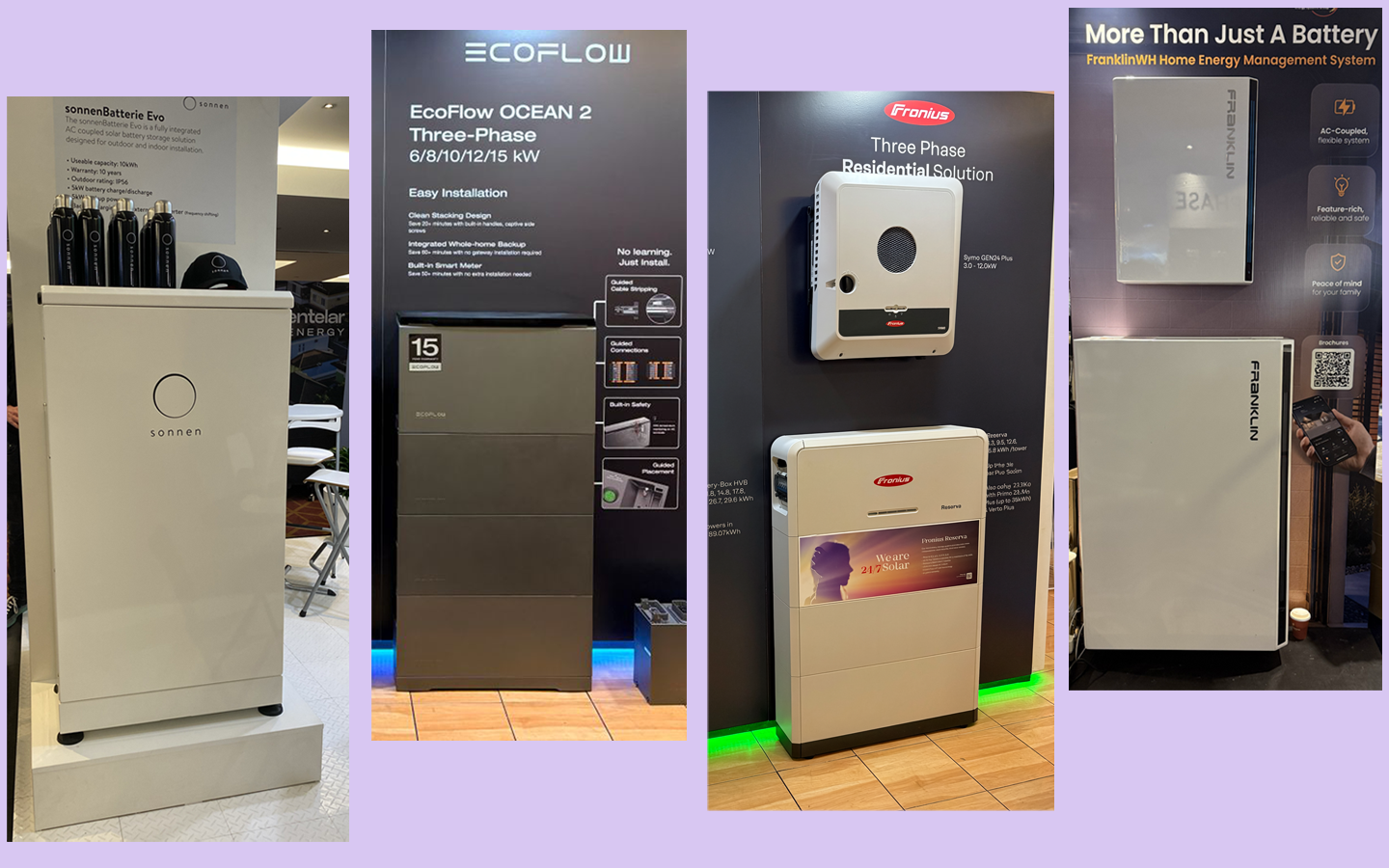
If you are pricing a 'home solar plus battery system' right now, here is the number you want: most people are landing somewhere between $30,000 and $35,000 according to My Solar Quote's recent survey.
We asked homeowners who had installed a system in the last 12 months what they bought and how much they paid. There prices are what people actually paid, rather than advertised deals.
Remember, solar + battery systems aren't something you buy off the shelf - they're customised to suit your home and how you use power. To find out what setup would work for you and what it would cost, get 3 free quotes.
Here’s what people told us.
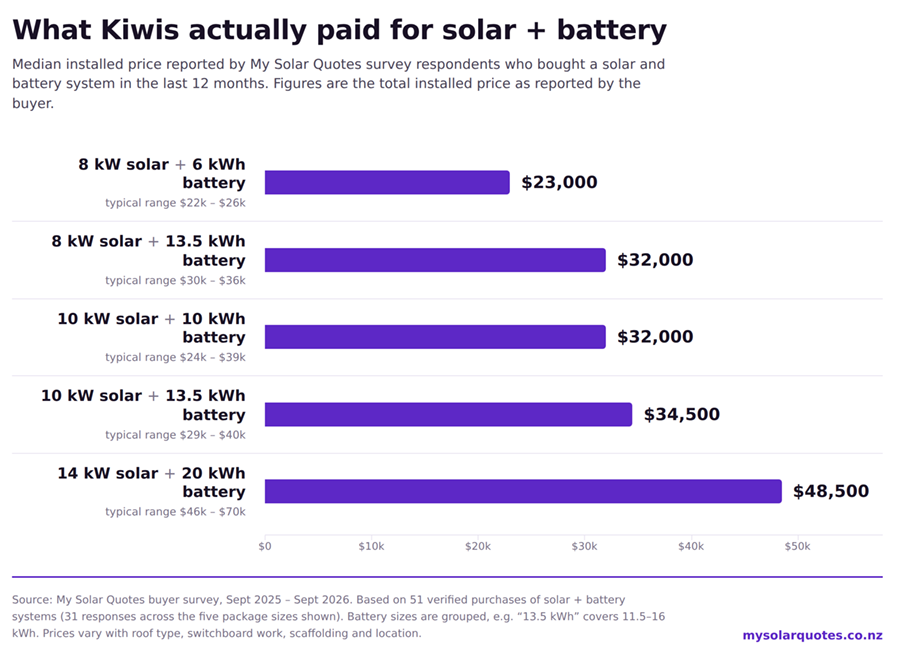
| System | Median installed price | Typical range |
|---|---|---|
| 8 kW solar + 6 kWh battery | $23,000 | $22k to $26k |
| 8 kW solar + 13.5 kWh battery | $32,000 | $30k to $36k |
| 10 kW solar + 10 kWh battery | $32,000 | $24k to $39k |
| 10 kW solar + 13.5 kWh battery | $34,500 | $29k to $39.5k |
| 14 kW solar + 20 kWh battery | $48,500 | $46k to $70k |
What these numbers tell you
Solar panels are cheap. Batteries are still the expensive bit. An 8kW system alone will cost roughly $15,500, add a battery and you could be paying an extra $7,500 to $16,500 depending on the battery size and model.
Solar + Battery Prices start at around $23,000. That is 8 kW of panels with a small 5 to 6 kWh battery. It's a good entry point price, but a battery that size will not get most households through an evening peak and a morning peak.
The ranges matter as much as the medians. Take the 10 kW solar plus 10 kWh battery package. Prices ranged from $24,000 to $39,000 for broadly similar systems. That’s a $15,000 difference. Things like roof type, switchboard upgrades, scaffolding and access to a two-storey roof can all add to the bill. Then there’s how competitive each installer is on price. A pretty good reason to get more than one quote.
One honest caveat: each of these packages only had between 4 and 9 buyers in our data. Use these figures to get a feel for whether your quote is reasonable, rather than expecting an installer to match them.
Why this matters more than it used to
A couple of years ago, batteries were still the optional extra that most households left off.
That’s changed pretty quickly.
According to the Electricity Authority’s EMI registry data, the share of new residential solar connections that included a battery was:
- 2024: around 29%
- 2025: around 37%
- 2026 so far: around 53%
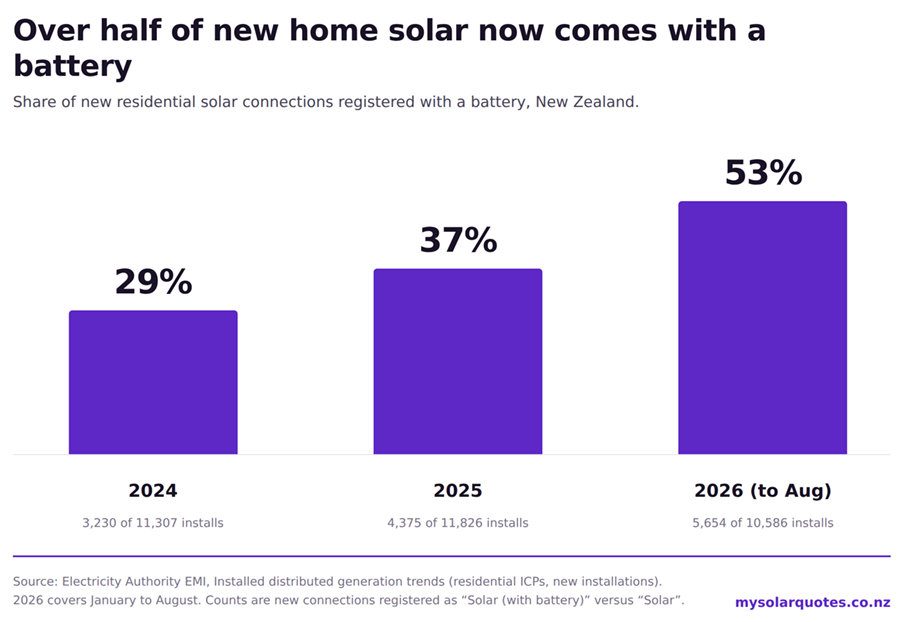
The total number of solar installs has not grown as drastically as the above graph. What has changed is what people are buying. Battery installs have gone from roughly 3,200 a year to 5,600 in eight months.
So the $30,000 to $35,000 spend on a complete solar power system isn't niche, it's the larger part of the market.
People are paying double for a longer payback
Here is the part that may seem strange...
In our 2026 payback data, solar-only systems had a median payback of 6.9 years, compared with 9 years for solar and battery systems. And as I covered in the $2 per watt reality, the battery roughly doubles the spend. The median solar-only system cost around $16,800, compared with $31,500 for solar and batteries.
Twice the money $$, three years longer to pay-back, and more than half of new installations now include one.
Why are Kiwis buying solar batteries?
We wanted to understand why, so we asked battery buyers to choose their single main reason.
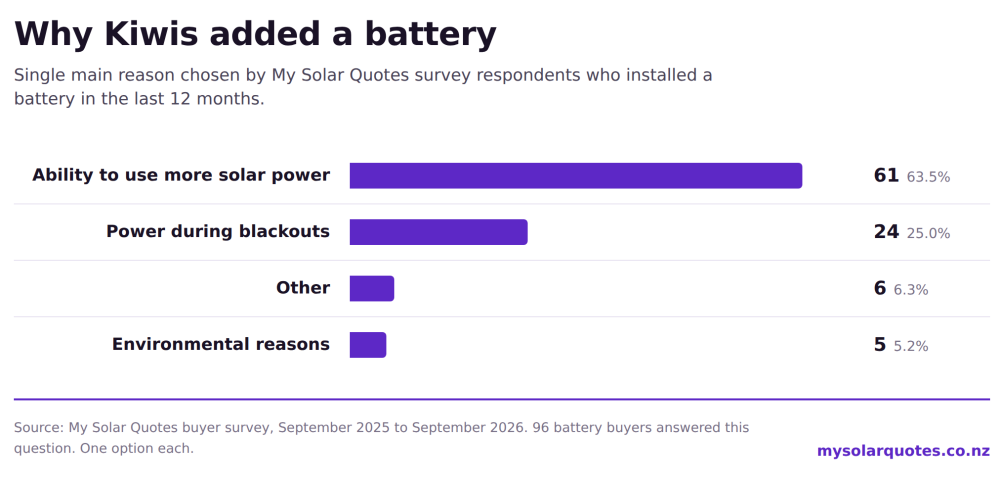
| Reason | Picked | Share |
|---|---|---|
| Ability to use more solar power | 61 | 63.5% |
| Power during blackouts | 24 | 25.0% |
| Other | 6 | 6.3% |
| Environmental reasons | 5 | 5.2% |
Nearly two thirds wanted to use more of their own solar power.
Fair! When you’re exporting power during the day for less than it costs to buy it back that evening, storing some for later has an obvious appeal.
A battery lets you keep more of that generation at home and use it when you need it.
It helps you fight back against rising power bills - although the upfront cost may sting a little. Thank goodness for 0% and low interest loans from the bank!
One in four buyers mainly wanted power during blackouts.
That’s a pretty sizeable group. For those households, the battery is doing another job alongside reducing the power bill. But I’d expect this reason to become even more common after the next natural disaster leaves households without power for days.
Environmental reasons were the main motivation for around 5% of buyers. That doesn’t mean the others don’t care about the environment, just that it wasn’t their number one reason for buying a battery.
For most, it came down to using their own power or keeping things running when the grid goes down.
Most batteries work in blackouts, but doesn't hurt to double check
RNZ ran a story on this on 12 September '26, which I was quoted in. The crux of the story being whether their battery is going to be useless in an outage.
Short answer: almost certainly not.
Every solar battery model sold in New Zealand today can provide backup power. A few years ago there were a handful that couldn't, but those are no longer on the market.
The catch is, just having a battery doesn't automatically mean you're sorted for a blackout. Your system needs to safely disconnect from the grid when the power goes out, so it doesn't send electricity back down the lines while someone is working on them. This is usually done with an automatic transfer switch. Depending on the battery, it can be an extra bit of hardware your installer needs to include.
I'd estimate around 90 percent of systems out there have backup enabled. From this year onwards, I'd expect that to be closer to 100 percent.
So if you're buying a system now, it's just something to ask about. Does your quote include backup power, and what will actually keep running? Some systems can back up the whole house. Others only back up essential circuits, keeping the fridge, lights and wifi going, but leaving things like the oven and heat pump off.
My advice: worth asking the question, ‘will my battery work in a power outage?’ I'm pretty sure the answer will be yes - but if you're spending around $30k, it's worth a quick check.
In short
If looking to get a typical sized solar + battery system budget for $30,000 to $35,000, but remember there are so many variables: sizes, brands etc. So get three quotes. And make backup power an explicit line item, not an assumption.






Post your own comment