

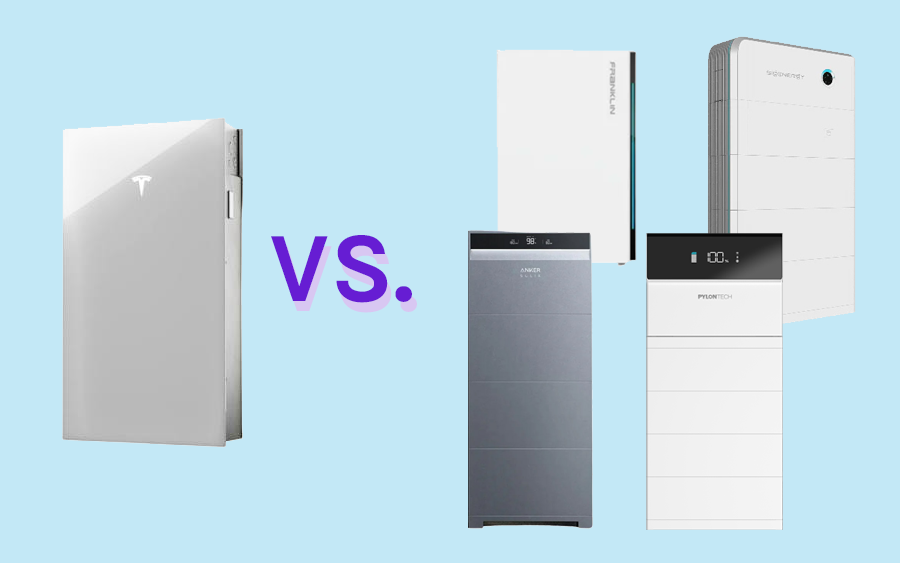
Few other home batteries on the market enjoy the kind of popularity that the Tesla Powerwall does. The latest, Powerwall 3, is a highly rated, modern solar battery with strong consumer interest. But it is not the only great battery on the market.
In this article, we’ll take a closer look at the Powerwall 3 and compare it to similar batteries available in New Zealand.
The Tesla Powerwall 3 (A Short Introduction)
Tesla’s Powerwalls have been around for over a decade now. The first model, despite being pretty basic by today’s standards, was considered quite advanced in 2015. The PW2, which came around 5 years ago, offered much stronger specs and features, and it made Tesla the market leader in home batteries.
A couple of years ago, the Powerwall 3 entered the market, and just like the PW2, it flaunted some major changes on the spec sheet. The PW3 isn’t one of the cheapest batteries on the market – its installed cost can cross the $20,000 mark – but its reliability and features still make it a great choice.
Let’s discuss the following aspects of the Powerwall 3, while comparing batteries with similar specs and features along the way:
- Usable Energy Storage.
- Power Output.
- Hybrid / Off-Grid Compatibility.
- Battery Chemistry.
- Warranty.
- Monitoring.
- Battery Inverter Included.
- Price.
Tesla Powerwall 3 Comparisons
Usable Energy Storage
The Powerwall 3 battery has the same energy capacity as its predecessor – it can store 13.5 kWh when fully charged. In New Zealand, the average home uses about 22 kWh per day. This makes Tesla’s 13.5 kWh capacity a sweet spot.
Currently, multiple battery options on the market offer capacities around 13.5 kWh. For example, FranklinWh’s aPower battery offers a 13.6 kWh capacity and is also fully off-grid capable, unlike the Powerwall. Similarly, BYD offers a 15.4 kWh capacity on its Premium LVL battery.
An important thing to note here is that brands are becoming more flexible with energy capacities, and while options with 10-15 kWh storage are decreasing, most batteries can be scaled to achieve anywhere from a few kWh to a few hundred kWh.
For instance, the Huawei Luna 2000 can be made to have a capacity ranging from 5 kWh to 30 kWh by stacking up modules. Likewise, the Sungrow SBR has a lowest capacity of 6.4 kWh, but can be expanded to have 102.4 kWh.
The Powerwall 3 is also a scalable battery, allowing you to achieve up to 54 kWh by connecting four powerwalls (or expansion units, if you want to save a few hundred bucks).
Power Output
A major upgrade from the second to the third generation Powerwall was its continuous power output rating. Unlike the PW2’s 5 kW rating, the PW3 can pump out 11 kW at a time. While the discharge rate is boosted to 11 kW, the charging rate remains at 5 kW, but that’s not a deal-breaker.
In NZ, export limits restrict the battery to 10 kW, which is still significant. You would rarely use the whole 10 kW power draw for extended periods of time, as it can drain a fully charged battery in just over an hour. But a higher power rating allows you to start power-hungry loads and absorb the surge.
The battery also houses three MPPTs, which allows you to install panels facing three different directions. This is particularly helpful if you have an oddly shaped roof or poor orientation. On a side note, when installing a system like this, your installer will probably oversize the array to account for orientation and other losses. A single Powerwall 3 can accept up to 20 kW of solar panels.
There are not many other batteries in New Zealand that offer 10 kW of continuous power output on the default configuration. However, most modern batteries are scalable, meaning you can always connect multiple units to get 10 kW or more of power output.
For instance, the SolarEdge 10 kWh home battery has an output of 5 kW. Connecting three units together boosts the power output to 15 kW, but it will also triple the storage capacity to 30 KWh, not to mention the tripling of your costs. That said, the Powerwall 3 is the only reputable option that offers 10 kW output with just 13.5 kWh capacity.
Hybrid/Off-Grid Compatibility
If you’re dreaming up a remote, fully off-grid homestead, and have your eyes set on the Powerwall, there is some bad news for you. According to Tesla, ‘Powerwall 3 systems must have a grid connection. Fully off-grid systems are not supported’.
While this may feel counterintuitive, off-grid batteries need more electronics and sophistication than regular home batteries. The PW3 does not have generator integration or advanced load management options, which are essential for a fully off-grid battery.
If you are interested in fully off-grid batteries, the previously mentioned FranklinWh is a good option. Similarly, Sigenergy’s Sigenstor is a notable, high-tech battery with off-grid capabilities.
Battery Chemistry
Over the past few years, the industry has gradually transitioned from the Nickel Manganese Cobalt (NMC) chemistry to Lithium Iron Phosphate (LFP) chemistry. LFP offers several advantages over NMC, such as longer life, better fire resistance, and more sustainable production.
Tesla hasn’t been the first mover in this area. Its Powerwall 2 had an NMC battery even though several competitors were already offering LFP. However, Tesla has finally caught up with the PW3, offering the LFP chemistry.
As for comparative options, most modern brands have now moved completely to LFP, including the likes of BYD, Pylontech, Sigenergy, Enphase, and others.
Warranty
The Powerwall 3 comes with a 10-year warranty, which is admirable, but not extraordinary. Most battery manufacturers now offer 10-year warranties, unlike the 5-year terms offered a few years ago. Tesla promises that by the end of this 10-year term, the battery will have at least 80% of its original capacity. There are a couple of conditions, though.
If your battery is not connected to the internet, your warranty gets shorter. Based on how infrequent your internet connection is, the warranty can get as low as just four years. Tesla also specifies that if your battery is used to send electricity into the grid, then the warranty becomes 10 years or a total of 37,800 kWh of stored energy.
Several other brands offer a 10-year warranty on their batteries, as mentioned earlier. Some examples are the Sungrow SBR series, Sigenstor, and the Enphase IQ battery. Note that your battery, whether it’s a Tesla or another reputable brand, will last longer than the 10-year warranty.
Monitoring
Some may complain that Tesla uses the same old monitoring app for the Powerwall 3. However, the app is well-designed and needs no changes. In fact, it is one of the best home energy monitoring apps right now. Tesla’s app monitors your solar panels, battery, and EV (if applicable).
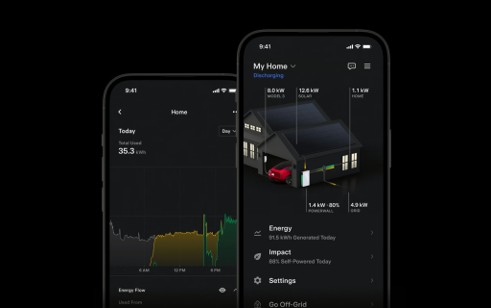 Tesla monitoring app (source: Tesla)
The app is both intuitive and sleek-looking. Although most other batteries come with some sort of monitoring app, no other app matches the usability and design of Tesla’s.
Battery Inverter Included
Unlike the Powerwall 2, the PW3 is a DC-coupled battery. It has its own integrated inverter. This allows you to connect the battery directly to your solar panels, instead of after the inverter. Other batteries on the market with integrated inverters include the Sigenergy Sigenstor and Alpha ESS.
An AC-coupled battery converts AC power from the inverter into DC power for storage, and again vice versa to supply AC power for the household. These multiple conversions result in losses, reducing the efficiency of AC-coupled systems.
DC-coupled systems have fewer conversions, allowing greater efficiency. However, DC-coupled systems are also less flexible, as you cannot connect a DC-coupled battery to an existing solar system as you can with an AC-coupled battery.
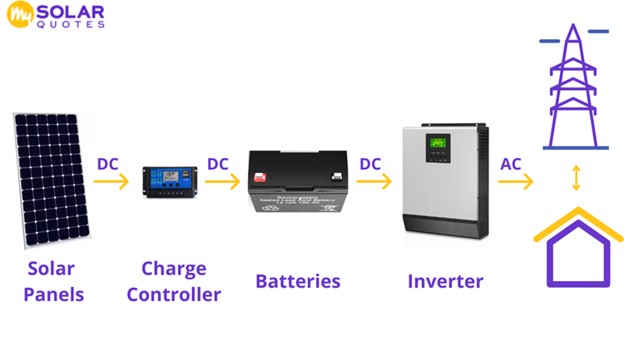
That said, the PW3 can be used as an AC-coupled battery if you want to install a battery without a solar power system. All you need to do is use its ‘Storage Only’ configuration and connect it to your home.
Plenty of solar batteries in NZ today are DC-coupled, such as the Fronius Reserva, Huawei Luna, Sungrow SBR, and Sigenergy’s Sigenstor.
Price
The previous generation Powerwall cost about $15,000 and didn’t have many notable competitors offering better features or lower pricing. But the battery market has accelerated rapidly, with umpteen brands and models flooding the market in just a decade.
The Powerwall 3 costs about $16,000 before installation. However, two things boost that number significantly.
First is the cost of the Backup Gateway 2, a device that is necessary for the solar battery to operate. This device is sort of the brain for your system – it disconnects the system during a blackout, switches to backup mode, and communicates with the app. The second is, of course, the installation costs.
Add both, and you are looking at spending anywhere near the $20,000 mark. Plus, if you have an outdated switchboard, upgrading that may add another few thousand dollars. Ultimately, the costing goes well over $1,400/kWh. At a time when $1,000/kWh is considered a reasonable price, Tesla seems a bit expensive.
Take the BYD Battery Box, for instance, whose installed cost lies between $800 and $1,000 per kWh of storage capacity. Similarly, the Sungrow SBR battery also costs $800-$1,000/kWh. Perhaps the only battery comparable to the Powerwall 3 in terms of pricing is the Enphase IQ battery, which costs $1,200/kWh or more.
Compare All Battery Specs With the Tesla Powerwall 3
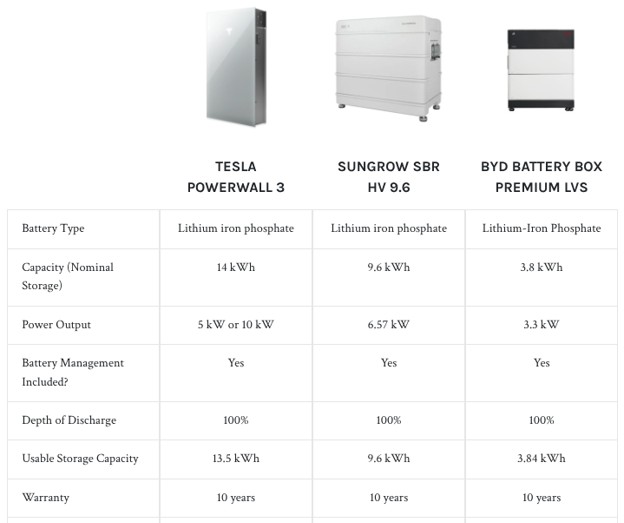
Let’s face it – buying a home battery is an expensive affair, and with the number of available options, buyers often have to spend countless hours comparing specs and features to find their perfect battery. This is why we created our battery comparison tool. Just select any three batteries you’d like to compare, and you have a tabulated list of the specs and features. Look at an example below. Neat, aye?
And if you feel like skipping this and simply speaking to installers about your needs and budget, we’ve got you covered there too – click here to get up to three free quotes from vetted installers for your solar battery, including no-cost consultations.


Post your own comment