


I opened my May/June power bill with the relaxed confidence of someone who has solar panels.
That confidence lasted about three seconds.
$536.03.
My first thought was, “Surely that must be for a couple of months?”
Because, full disclosure, I am slightly allergic to paying power bills. Somewhere deep down I seem to believe cheap power is my god-given right, so I am not always the most prompt payer.
But no. I checked properly.
It was one month.
Which made me indignant all over again, because I have solar panels.... Surely, surely, a household with solar panels should not be getting a $536 power bill.
Then I remembered a few things.
Ah that's right, it's winter, and those $100 power bills from during summer are a far away dream.
And something else to factor in - when the latest oil shock hit, I did what any calm, rational person staring down another fuel price spiral would do... I panicked.
I rushed off to our local car dealership and traded our diesel vehicle for an electric car, which means we now have two EVs charging at home. Very sensible. Very future-facing. Also, apparently, very visible on a winter power bill.
So, yes. Annoyingly, the bill was probably accurate.
But the part that really got my attention was this:
Of that $536.03 bill, $101 was fixed charges.
Not electricity I used. Not EV charging. Not the dryer. Not the heat pump.
Just the cost of being connected.
There is no clever appliance setting for that. No “turn it off at the wall” hack. No stern family meeting about shorter showers, because showers are for getting clean, not contemplation booths.
That $101 lands before you really start doing anything.
And that sent me down a rabbit hole.
Because while my own bill has a few obvious explanations, the bigger picture is much more interesting. Across New Zealand, households are actually using less electricity than they used to. But we are paying more for it.
A lot more.
New Zealand households are now using less electricity than they have in years, yet the average annual power bill has just hit a record high.
That sounds backwards, but the data tells a pretty clear story. We have become more efficient, but the way we pay for electricity is changing underneath us.
And that matters, because it changes what households can actually do about their winter power bills.
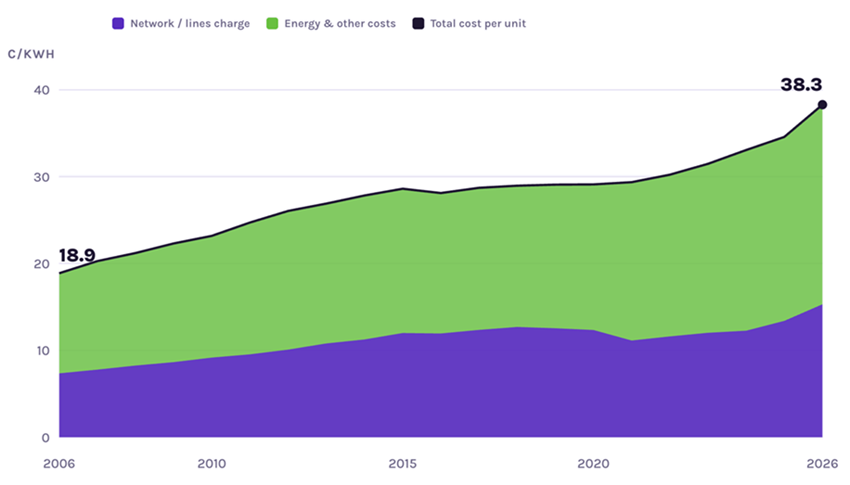
The price of electricity has roughly doubled
Source: MBIE sales-based electricity costs.
The price of a unit of household electricity has roughly doubled in 20 years, from 18.9c to 38.3c per kWh.
For a long time the rise was fairly gradual. But since 2024, it has kicked up sharply. And the bit doing a lot of the lifting is not just the electricity itself. It is the network charge - the cost of the poles, wires, transformers and the national grid.
Not exactly the sexiest part of the power bill. But probably the bit we all need to start paying more attention to.
We are using less power, but spending more
If your power bill felt heavier this winter, you are not imagining it.
And weirdly, you are probably not using more power.
BTW - I am definitely not reflected in this data.
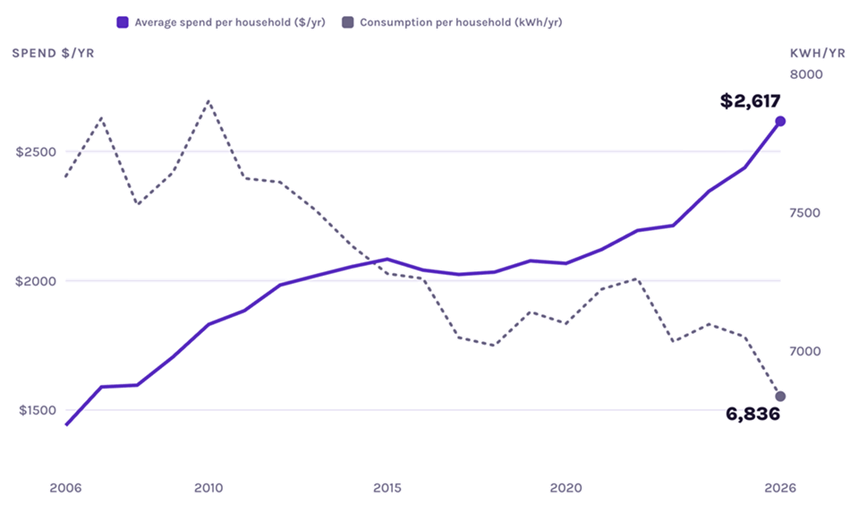
The average New Zealand household now uses about 6,836 kWh a year. That is the lowest figure in the 20 years MBIE has been publishing this data.
In 2006, the typical home used 7,630 kWh a year. So we have cut more than 10% off our electricity use.
That makes sense. Heat pumps have replaced oil heaters. LED bulbs have replaced old-school light bulbs. Homes are better insulated than they used to be. Appliances are more efficient. We have been doing the right things.
And yet the average household electricity bill has just reached $2,617 a year. That is an all-time high, and it is up 7.4% in one year.
Source: MBIE sales-based electricity costs.
Less power in. More money out.
When you put those two lines on the same chart, they do not just drift apart. They tell you something has changed in the relationship between using electricity and paying for it.
The biggest annual jump in 20 years
In the year to March 2026, the cost of a unit of electricity jumped 10.8%.
That is the single biggest annual rise in the 20-year record, in both nominal and inflation-adjusted terms.
For most of the last decade, this was not happening. Once you adjusted for inflation, the real cost of electricity actually drifted down from 2015 to 2024.
Power was one of the few household costs that had been quietly behaving itself.
That period looks like it is over.
In the year to March 2026, real electricity prices climbed back to their 2015 peak. So in today’s dollars, electricity is now about as expensive as it has been in the last decade.
01 - It is the wires, not just the watts
Your power bill is really two bills bundled into one.
There is the energy part. That is the actual electricity, generated at a dam, wind farm, geothermal station, solar farm, gas plant, or wherever it comes from, and sold to you by your retailer.
Then there is the network charge, often called the lines charge. That is the cost of physically getting that electricity to your house through poles, wires, transformers and the national grid.
Together, transmission and distribution make up just over 30% of the average bill.
And when you split the recent increase into those two parts, the culprit becomes pretty obvious.
In the year to March 2026:
- Energy and other costs rose 8.6%
- The whole bill rose 10.8%
- Network and lines charges rose 14.2%
So the lines part rose almost twice as fast as the rest of the bill.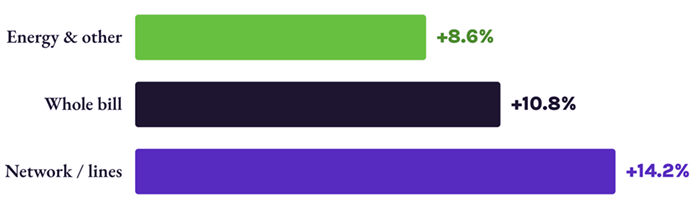
Source: MBIE’s most recent quarterly snapshot (to 15 May 2026)
In MBIE’s most recent quarterly snapshot, to 15 May 2026, the split is even more obvious. The lines component jumped 10.7% in a single quarter, while energy and other costs actually fell 0.8%.
That is a pretty big clue.
This is not a random glitch in the system. It is partly policy arriving on schedule.
From 1 April 2025, the Commerce Commission reset the rules that cap how much lines companies and Transpower are allowed to earn. This is called the default price-quality path, or DPP4. The new limits run to 2030, and they are deliberately higher.
The Commission has been pretty clear about why.
A lot of the electricity network was built in the 1960s and 70s and is wearing out. Storms like Cyclone Gabrielle have shown how much resilience work is needed. Electrification is increasing demand. And the interest rate the regulator allows networks to earn has been reset from 4.57% to 7.10%, because borrowing has become more expensive.
The Commission estimated this would add about $10 a month for the average household in year one, and up to $25 a month in some regions.
In its own words, these costs started rising in 2025 and are likely to keep rising until at least 2030.
...Delightful.
To be fair, it is not only the networks. The Commerce Commission has noted that about 40% of the recent rise is retailers passing through their own higher costs, including a wholesale market that is still unsettled after the 2024 dry-year crunch.
But step back and there is a clear theme: everyone in the energy chain wants more reliable revenue.
It is a bit like your local cafe charging you a fixed weekly fee because you pop in irregularly. Sometimes once a week, sometimes twice, sometimes not at all. The cafe wants certainty. Fair enough. It still has rent, staff and a coffee machine to pay for.
But from your side of the counter, it would feel pretty strange to pay $10 just for the right to maybe buy a flat white.
Yes, this analogy makes the whole thing sound a bit ridiculous. Because, from a household’s point of view, it kind of is. Not ridiculous because the costs are fake, but ridiculous because the fairness starts to feel very wobbly.
The regulated, scheduled, unavoidable part of the bill - the wires - is the part climbing fastest. And it has the clearest runway.
You can see that policy moving across the map.
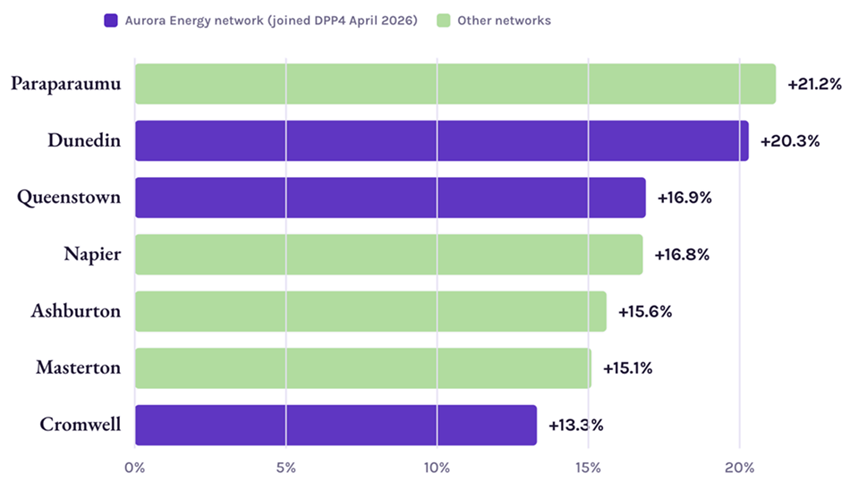
The biggest one-quarter network jumps in the latest MBIE snapshot were in places like Dunedin, Queenstown and Cromwell. Those are all served by Aurora Energy, which had been on a separate regulatory path and only joined DPP4 on 1 April 2026.
The reset reached them later, so their bills lurched later.
Source: MBIE Quarterly Survey of Domestic Electricity Prices.
02 - The charge you cannot switch your way out of
This is where the fixed daily charge becomes more than just an annoying line on the bill.
It changes the whole psychology of saving power.
Since 2004, New Zealand capped the daily fixed charge for low-user plans at 30c to help smaller households. In 2019, a government review found the cap was not well targeted. It often helped wealthier households with low-use homes, while pushing some low-income, high-use families into more expensive plans.
So the cap is being phased out.
Each April, the cap rises by 30c:
- Before 1 April 2022: 30c per day
- From 1 April 2026: $1.80 per day
- From 1 April 2027: the cap is gone
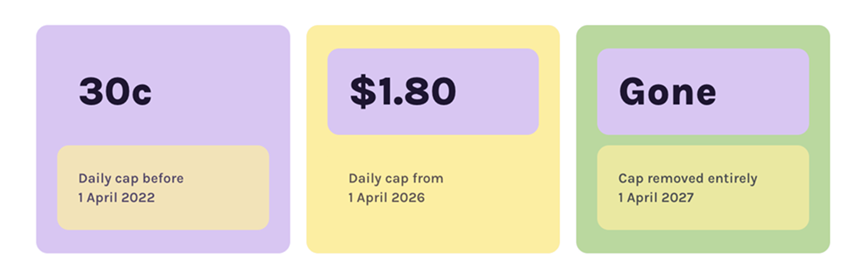
That is a six-fold rise in the regulated daily charge over five years, and then no cap at all.
Networks are moving in the same direction with their own fixed line charges. Vector lifted its low-user daily line charge from 75c to 90c this year. Powerco raised its from 60c to 75c.
The goal is to rebalance the fixed and variable parts of the bill.
And this is the bit households really need to understand:
A fixed charge is a charge you cannot conserve your way out of.
You can turn off every appliance, shiver through July in the dark, and the daily charge still lands.
As that fixed slice grows, the reward for using less electricity gets smaller.
That does not mean efficiency is pointless. It absolutely still matters. But it does mean the old advice of “just use less power” is becoming a weaker answer than it used to be.
03 - So what can you actually do?
Strip the whole story back, and households have two main levers.
First, use less - but be smarter about it
Using less still helps. I do not want to downplay that.
But the smartest savings are now less about total use, and more about when you use power.
By the end of June 2026, every large electricity retailer must offer a time-of-use plan. These plans charge less at certain times, usually overnight and sometimes during the middle of the day, and more during morning and evening peaks.
So shifting the dishwasher, EV charging, hot water cylinder or washing machine into cheaper periods can make a real difference.
It is also worth checking your plan again. With low-user plans unwinding, the plan that suited you in 2022 may now be the wrong one.
Using those power bill websites are a good place to start.
But there is a limit to what conservation can do.
The fixed daily charge is still there. The network charge is still baked into every unit. And both are designed to keep climbing through to 2030.
Second, make your own power
This is the lever that changes the maths the most.
Rooftop solar does not just trim your usage. It lets you stop buying some of those grid units at 28c, 35c, or 38c each, and replace them with electricity you generate yourself.
Over a system’s life, solar power can work out at roughly 11c per unit.
So every year grid prices climb, the gap gets wider.
That is why the case for self-generation is getting stronger, even though solar has been around for a long time.
New Zealand’s rooftop and small-scale solar capacity grew 44% in 2025, which was a record year. But only around 3-4% of homes have panels, compared with more than 30% in Australia.
So we are growing fast, but still from a very small base.
A typical 6.6kW solar system now costs around $10,000-$13,000 installed. Payback periods are often around 5-8 years.
The case is also getting stronger because the electricity market is slowly being pushed in a more solar-friendly direction. Large retailers must offer fairer rates for exported power at peak times from July, and better time-of-use plans should give households more ways to shift demand and make the most of their own generation.
None of this means solar is magic.
It will not erase your fixed daily charge. If you stay connected to the grid, you still pay to be connected.
Batteries are useful, especially for backup and using more of your own solar, but they still tend to have longer paybacks. For many households, they are bought for resilience as much as savings.
And the upfront cost of solar is real money. Not everyone has $10,000 sitting around waiting for a good spreadsheet.
But the structural logic is hard to argue with.
New Zealand has built a power bill where the cost of using electricity is being slowly overtaken by the cost of being connected to it.
That connected cost is set to rise through to 2030, and most households have very little control over it.
Against that, the one move that shifts the maths back in your favour is to stop being only a customer of the grid, and start producing some of your own power.
For two decades, getting more efficient was enough to help keep your bill in check.
The data suggests that bargain is starting to expire.
So what am I going to do?
The obvious answer, for my own house, is more solar.
I have a large east-facing roof with no panels on it yet, and I could probably add another 6kW to my already 8.2kW system. I would also double my battery size if I was making the perfect spreadsheet decision.
But, annoyingly, life is not lived inside a spreadsheet.
Other household costs have priority right now, so the solar upgrade will have to wait its turn. Probably until the next power bill shock, when it suddenly gets bumped to the top of the queue.
In the meantime, I’ll be watching for better time-of-use power plans, because managing when we use power is going to matter more and more. Two EVs, a dryer constantly spinning, winter heating, hot water - it all adds up.
And next time I open the power bill, I’ll prepare myself properly.
Maybe a cup of tea and calming mantra.
Something like:
“I am no longer paying for fossil fuel at the pump. I am no longer paying for fossil fuel at the pump. I am no longer paying for fossil fuel at the pump.”
Then I’ll open the bill.
Carefully.
Sources
MBIE - Sales-based electricity costs and Quarterly Survey of Domestic Electricity Prices, to 15 May 2026
Commerce Commission - Understanding why changes to lines charges may impact your electricity bill, and the 2025 DPP4 reset
MBIE - Mid-point review of the phase-out of the Low Fixed Charge regulations
RNZ - “Terrible timing but pending power price increase justified”
Vector and Powerco - 2025/26 pricing and reasons for change disclosures
Electricity Authority - Regional power prices dashboard
PV-Tech / Solar Power in New Zealand - 2025 solar growth, system costs and payback


Post your own comment