

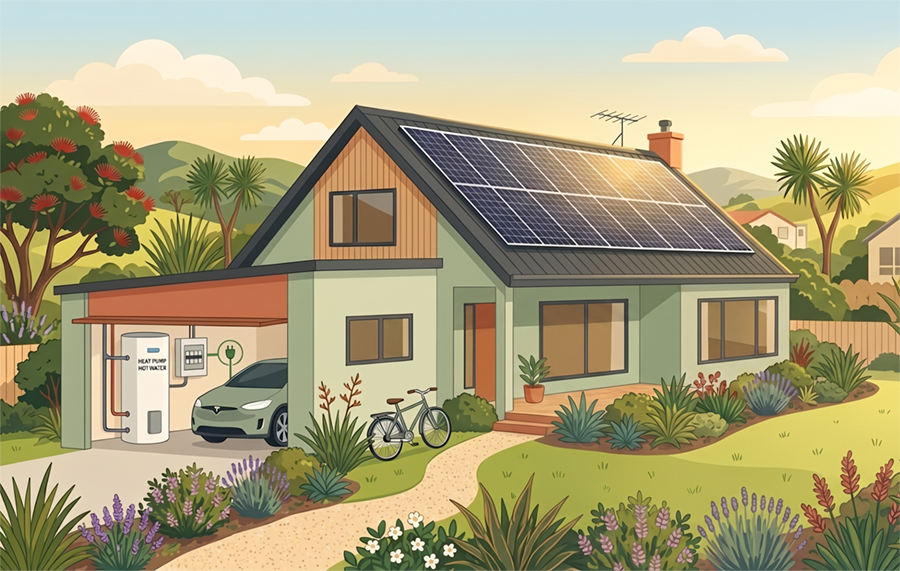
No, you don't have to disconnect from gas the day your solar panels go in. But if you're asking whether you should — the answer is almost certainly yes, and hot water is where to start.
Here's why that matters more than most people realise.
Solar works best when you have somewhere to send the energy
A solar system generates most of its power in the middle of the day, when a lot of households aren't home using it. That surplus either gets exported to the grid at a pretty average buy-back rate — typically 8–12 cents per kWh in NZ — or it gets used on-site at something closer to full retail value (around 28–35 cents per kWh depending on your plan).
The economics of that gap are pretty clear. You want to use as much of your own solar as possible.
A hot water cylinder is one of the best "sponges" for that daytime generation. It can absorb a large chunk of surplus solar — heating water that your household will actually use — and it does it quietly, without you having to think about it. Set your cylinder's timer to run during peak solar hours, or add a simple solar diverter, and you've turned free midday sun into free hot showers.
Hot water is roughly a third of your power bill
That's not a rough guess — it's a consistent figure across NZ household energy data. Heating water is one of the biggest single loads in most homes. If you're currently doing that with gas, you're paying for gas supply, a gas appliance, and a gas connection — and none of that is cheap.
Switching to an electric hot water cylinder (or a hot water heat pump, which is even more efficient) and pairing it with solar generation is one of the highest-impact moves you can make. The payback on that combination is real and relatively quick.
The gas fixed charge problem
Here's the thing that often gets overlooked. Even if you barely use gas — maybe just for a cooktop — you're still paying a daily fixed connection charge. In NZ that typically runs around $1.50 to $2.00 a day, just to keep the gas connected. That's $550–$730 a year before you've burned a single cubic metre.
If you've already shifted your hot water to solar-powered electric, your gas usage drops considerably. But the daily charge doesn't. You're essentially paying a subscription to a service you're barely using.
Cutting the gas connection entirely removes that fixed cost completely. For many households, that saving alone covers a decent chunk of the solar system's running costs.
And gas prices are only heading one way
This isn't scaremongering — it's supply and demand. The Ministry of Business, Innovation and Employment has reported that NZ's gas reserves are falling faster than previously estimated, with roughly six years of supply left at current consumption rates.
Consumer NZ has warned of a potential "death spiral effect" — as more households disconnect from gas, the cost of maintaining the gas infrastructure gets spread across fewer users, pushing prices up further and encouraging even more people to leave. Consumer was expecting average gas price increases of around 10% in the near term, and that trend isn't going to reverse.
If you stay on gas, you're betting on a fuel source that's running short and getting more expensive. That's not a great position to be in when you've just invested in a solar system designed to reduce your energy costs.
You don't have to do it all at once
The sensible approach is to start with hot water. If your existing gas hot water system is ageing, replace it with an electric cylinder or hot water heat pump when it's due — don't rip out a perfectly working appliance just for the sake of it. But when the time comes, go electric.
After that, a gas cooktop is usually the last thing standing. Induction cooktops have come a long way and are worth a look when your hob is due for replacement.
The goal isn't to electrify everything overnight. It's to have a plan so that each time something reaches end-of-life, you replace it with an electric alternative — and gradually remove the gas connection charge from your life altogether.
The real takeaway
Going solar without thinking about gas is like fixing half a leak. The panels are a great start, but the full savings — financial and environmental — come when your whole home runs on electricity you're generating yourself.
Hot water first. That's where the numbers make the most sense, and it's the easiest place to start.






Post your own comment